
In today's global market, navigating the complex world of data compliance can feel like deciphering an alphabet soup of regulations, from SOC 2 and ISO 27001 to GDPR and HIPAA. For any company handling customer data, meeting these standards is no longer optional. It's the bedrock of customer trust, a non-negotiable requirement for winning enterprise deals, and the ultimate defense against costly breaches.
Understanding and implementing the right controls is the key to transforming compliance from a business hurdle into a competitive advantage. This guide will lay the foundation by decoding one of the most critical frameworks in the SaaS world: SOC 2. We'll break down what it is, why it matters across a range of industries, and how the right tools can provide a clear, direct path to achieving compliance.
What is a SOC 2 Report?
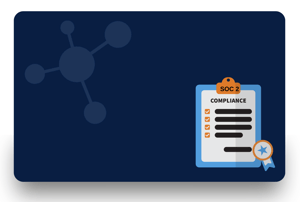
A SOC 2 report serves as the gold standard for demonstrating data security and operational maturity. It's built on a framework for managing customer data based on the five "trust services criteria": security, availability, processing integrity, confidentiality, and privacy. For any organization handling customer data, understanding and achieving SOC 2 compliance is a critical business function.
The High Cost of Non-Compliance
Failing to meet SOC 2 standards isn't just an audit issue; it's a direct threat to your growth and reputation. The consequences are significant and can impact every part of your business:
- Loss of customer trust
- Inability to win enterprise deals
- Breach of contract
The Bedrock of SOC 2: The Five Trust Services Criteria
SOC 2 is built upon five principles known as the Trust Services Criteria (TSC), each designed to address a fundamental question about how an organization manages and protects customer data.
- 01 — Security: How is my system protected against attacks?
- 02 — Availability: How do we decide when to make data from the system available?
- 03 — Confidentiality: When information must be shared, what keeps the exchange secure?
- 04 — Processing Integrity: Does the system work the way it needs to?
- 05 — Privacy: How do we ensure the system keeps private information safe?
While all five criteria are important, key data requirements are derived from them. For a detailed look at all the criteria, you can reference the official 2017 Trust Services Criteria document from the AICPA.
SOC 2 Across the Industries: A Sector-by-Sector Breakdown
While these principles are universal, their application is unique to the data and risks inherent in each industry.
- Technology / SaaS: As custodians of client data, SaaS providers use SOC 2 as the primary way to provide assurance that this information is secure.
- Finance, BFSI, and Publicly Traded Companies: SOC 2 is critical for complementing regulations like the Sarbanes-Oxley Act (SOX) by providing auditable proof of controls over financial data integrity.
- Healthcare: This framework supports HIPAA compliance by ensuring sensitive patient health information (ePHI) is protected and recoverable.
- Manufacturing & Automobile: SOC 2 provides a framework to protect critical intellectual property and operational data in smart, connected industrial environments.
- Defense & Public Sector (PSU): SOC 2 is essential for demonstrating the high assurance required to handle sensitive government data and maintain contracts.
- Utilities: This framework helps protect critical infrastructure by ensuring the integrity and availability of the operational systems that power our communities.
- Education: SOC 2 helps educational institutions prove they have effective controls in place to protect vast amounts of personal student and faculty data.
- Shipping & Logistics: This framework ensures the resilience and integrity of the data that powers the global supply chain, preventing costly disruptions.
The Revyz Advantage for SOC 2 Compliance
Achieving SOC 2 compliance requires having the right tools to enforce and prove your controls are effective. Revyz provides a direct path to mastering these requirements with a suite of dedicated tools:
- Backup & Restore
- Relevant Feature: This applet ensures data availability and recoverability by providing automated, off-site, and immutable backups.
- SOC 2 Connection: It directly fulfills the Availability (A1.2) requirement by ensuring data can be restored from secure backups after an incident.
- Config Manager
- Relevant Feature: It creates a formal, auditable change management process that includes versioning and the ability to roll back changes.
- SOC 2 Connection: This directly addresses the Change Management (CC8.1) requirement by operationalizing the entire change process with auditable workflows.
- Config Drift Analyzer
- Relevant Feature: This applet acts as a detective control, continuously monitoring for any unauthorized configuration changes against a trusted baseline.
- SOC 2 Connection: It supports the Change Management (CC8.1) requirement by providing the continuous monitoring needed to detect undocumented or unauthorized alterations.
- Audit Logs Backup
- Relevant Feature: It provides a verifiable and tamper-proof trail for forensic investigations by securing audit logs with long-term retention.
- SOC 2 Connection: This applet supports the Monitoring & Incident Response (CC7.2, CC7.3) requirements by securing audit logs in an immutable vault, ensuring evidence is always available for forensic analysis.
For a general overview of the SOC 2 framework, you can visit the AICPA's main page on System and Organization Controls (SOC).
Ultimately, compliance is more than an audit; it's a blueprint for building a resilient and trustworthy organization. In a world where your customers are increasingly aware of data risks, a SOC 2 report is your most powerful statement that you take their trust seriously.